
Paul Stamets and the Fungal World
How to Change Your MindPaul Stamets’s path from a life-changing mushroom experience to mycology and ecological advocacy illustrates how personal conviction can energize both useful work and speculative claims.
increasing Bearing strength in each event
 decreasing
Bearing strength in each eventdecreasingA Brother’s Influence
Looking Toward John
A model of inquiry
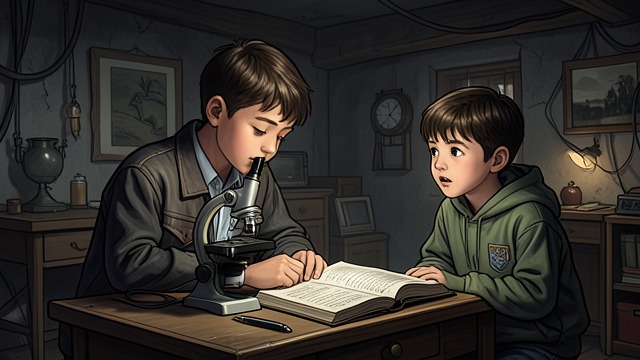
Paul Stamets grows up admiring his older brother John’s basement laboratory and scientific curiosity. A book about altered states, later burned by a friend’s parents, deepens his sense that consciousness is worth exploring.
Curiosity becomes vocation
Those early encounters link scientific ambition with forbidden knowledge. They help orient Stamets toward the mushrooms that will shape his work and identity.
The Storm and the Tree

A Pivotal Mushroom Journey
A frightening ascent
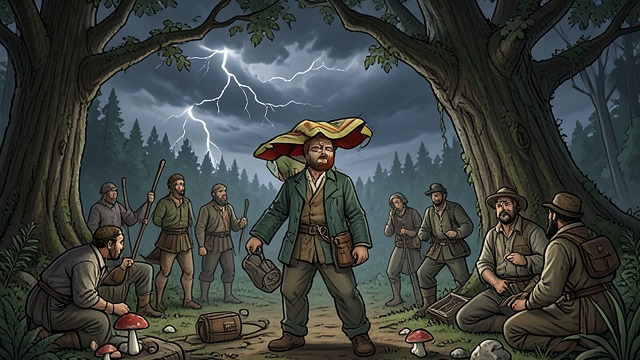
Stamets eats a large amount of mushrooms, climbs an oak, and finds himself caught in a thunderstorm. The tree becomes an anchor as fear and a sense of unity rise together.
A change in speech
He repeats a resolve to stop stuttering. The next morning he speaks without the familiar impediment, an event he remembers as the turning point that directed him toward mycology.
The Pacific Northwest Discoveries
A New Field of Study
Learning outside the academy
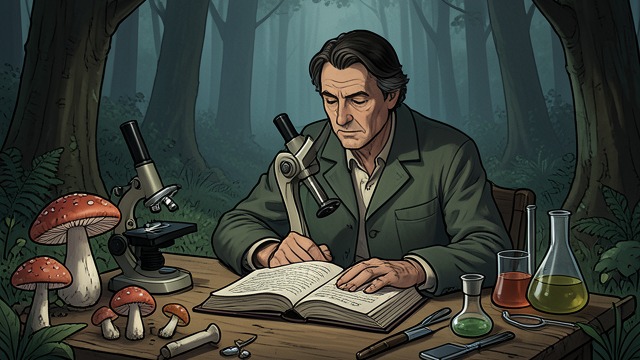
At Evergreen, Stamets and colleagues study Psilocybe species, cultivation, and chemical measurement. Their work shifts attention toward mushrooms growing in the Pacific Northwest.
Expertise and independence
Stamets builds authority through fieldwork and publication rather than conventional academic credentials. His combination of careful identification and broad claims will remain characteristic of his public role.
Mushrooms as Ecological Tools
From Mycology to Application
Practical experiments
Stamets develops projects involving mycoremediation, medicinal fungi, and pest control. His company turns fungal research into products and demonstrations that make the kingdom visible to a wider public.
A sweeping vision
His ecological metaphors sometimes outrun established evidence, but his practical achievements complicate dismissal. The book presents him as both an inventor and a speculative interpreter of nature.
A Messenger from Nature
A Mycocentric Worldview
The forest as network
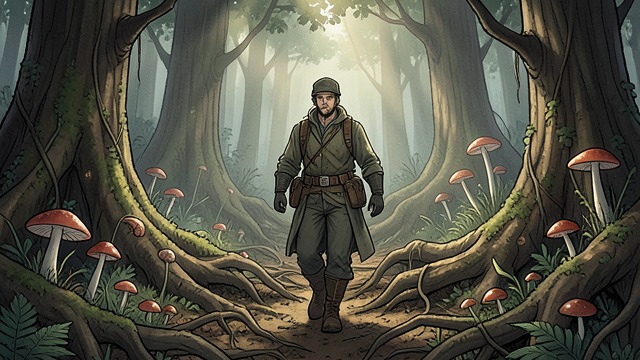
Stamets describes fungal webs as communicative systems linking trees and organisms. Research on mycelia gives some support to the idea that forests are more interconnected than ordinary perception suggests.
Science beside speculation
He interprets mushrooms as messengers that may guide human evolution and ecological responsibility. Pollan remains skeptical of the grandest claims while recognizing the imaginative power that drives Stamets’s work.
During Stamets’s childhood
During his first year at Kenyon College
During the 1970s
From the 1980s into the 2000s
During Pollan’s Washington visit
